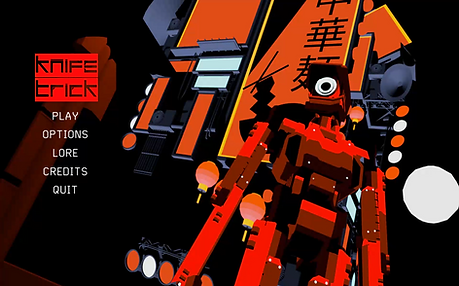
I was the sole designer on the project, responsible for documentation, level design, and gameplay balancing.
Responsibilities:
-
Created and maintained the backend documentation.
-
Created a gym to test the mechanics and measure the metrics of the game, and using said metrics to create and design the level.
-
Made a tutorial level with an initial blockout, and further changes based on playtest feedback to better teach the player the main mechanics.
-
Created the main level through an initial blockout, and expanded level needs with playtest feedback.
-
Worked with user research in running playtests to analyze player behavior with mechanics.
-
Designed and balanced the game. Created ranged and melee enemies to engage with the player, and balanced them accordingly. Collaborated with weapon design and balanced weapons accordingly.
Main Level
The main level was a challenge, because it needed to fill a couple of requirements. First, it needed to be a space that was evolving with gameplay and the player. It needed to constantly put the player on edge when enemies were present. This was an issue we ran into early into development, as it was easy for the players to stay in one space and fire, without any risk of danger. They didn't have to move because of the weapon placement being very close to each other, and there wasn't a lot of room for anything else.
The solution we found was twofold. The first thing was the engineering front made enemy spawners, that distributed the enemies across these different spawners placed in the world. I was then able to place these spawners, and set appropriate values for the radius that they spawned in, so that no matter where the player was present, there would be an enemy in some direction, possibly even behind the player, but still making the player uncertain of where enemies could come from, and keeping them on the edge.
The second solution we had was to make the different weapon purchasing stations have a cooldown for each one. The player would be forced to find more weapons over time, and look for visual indicators of some later along the line. I was then able to experiment with this, and spread out the different types of weapons throughout the level, and test that out.
Both of these allowed us to add more platforming elements to the level, allowing the player to move throughout the level to look for different weapons, as well as health point stations that healed the player after they took damage.
The main level taught me a lot about how to make a space interesting, and how to find the balance between tension and release of gameplay, and making a space that the player will revisit interesting after multiple runs and playthroughs.
Game Balance
Balancing the game was something I was new to, and learned a little bit on account of the first two studies I did with the mechanics gymnasium. This was the first thing that I worked on, especially with the platforming, as it was essential to the movement of the character. The gymnasium also helped with balancing the enemy and knife values in order to make sure we were getting the proper feel and function of the knives all made out.
After the gymnasium, balancing was split between the enemies and the weapons. Each weapon was a knife that was thrown by the player, and required balance in making sure that the way that it was intended to be used was clear to the player, and that the proper way that it was used felt satisfying and worthwhile. For example, one of the knives that we used was one in the shape of a boomerang, where the central mechanic was that it was the only one that could come back to your hand. This required the knife to feel and act like a boomerang to the player, as well as be viable as an option for the knife to go backwards as well. We also needed to make sure the throwing arc of the boomerang was challenging enough to require thought while throwing, in order to make the most of it in the game.
We also created a points system to give the player health pickups, rewarding them for choosing to give a more varied playstyle. We had specific challenges that our team collaborated on and established to reward the player with more points to use on health items.
The biggest help and learning experience that came with this was collaborating with user researchers. I learned a lot in terms of communicating the experience that was presented, and it helped with managing some of the tougher problems. One of the bigger instances of this was balancing the enemies to suit a larger horde-style game mode. Initially, I struggled with this, but working with the user researchers and playtesting helped a lot in where to move the design direction so we could get the experience we hoped to convey with the game.
Tutorial Level
The tutorial level was by far the most challenging aspect in terms of design, simply because I struggled with trying to teach the player the different mechanics. The first draft I did of the tutorial level mapped out some of the basic things that we wanted present, but struggled in teaching the player combat. It focused way too much on the platforming before introducing the most crucial element of the game. The final product ended up starting with a short platforming section for the player to get used to the basic platforming elements, and then having a detailed walkthrough of how to use the different weapons that you came across during the game.
Enemy Design
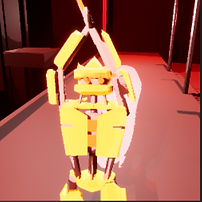
Enemies were the primary thing I created with documentation, with consultation with the art team. The different enemy types started out as being split into three main points, the first one being melee, the second being ranged, and the third one providing support for the enemies. Support enemies ended up being cut due to time crunch, but melee and ranged enemies stayed the same.
Melee enemies were based on a base enemy that had a single melee attack in a medium succession. I then took this enemy, and tried tweaking different set values in order to change the nature of the attack, and the nature of approach when it came to how the player would interact with this enemy. For example, for one enemy, I focused on the speed, leaning into an enemy that focused on a quick attack towards the player.
Ranged enemies followed a similar principle, but were also saddled with the pressure of keeping the player moving around the arena, and having them pay attention to the environment around them. Most of this focused on the type of projectile that the enemy was firing, and how that would get the player to move to avoid the attack.